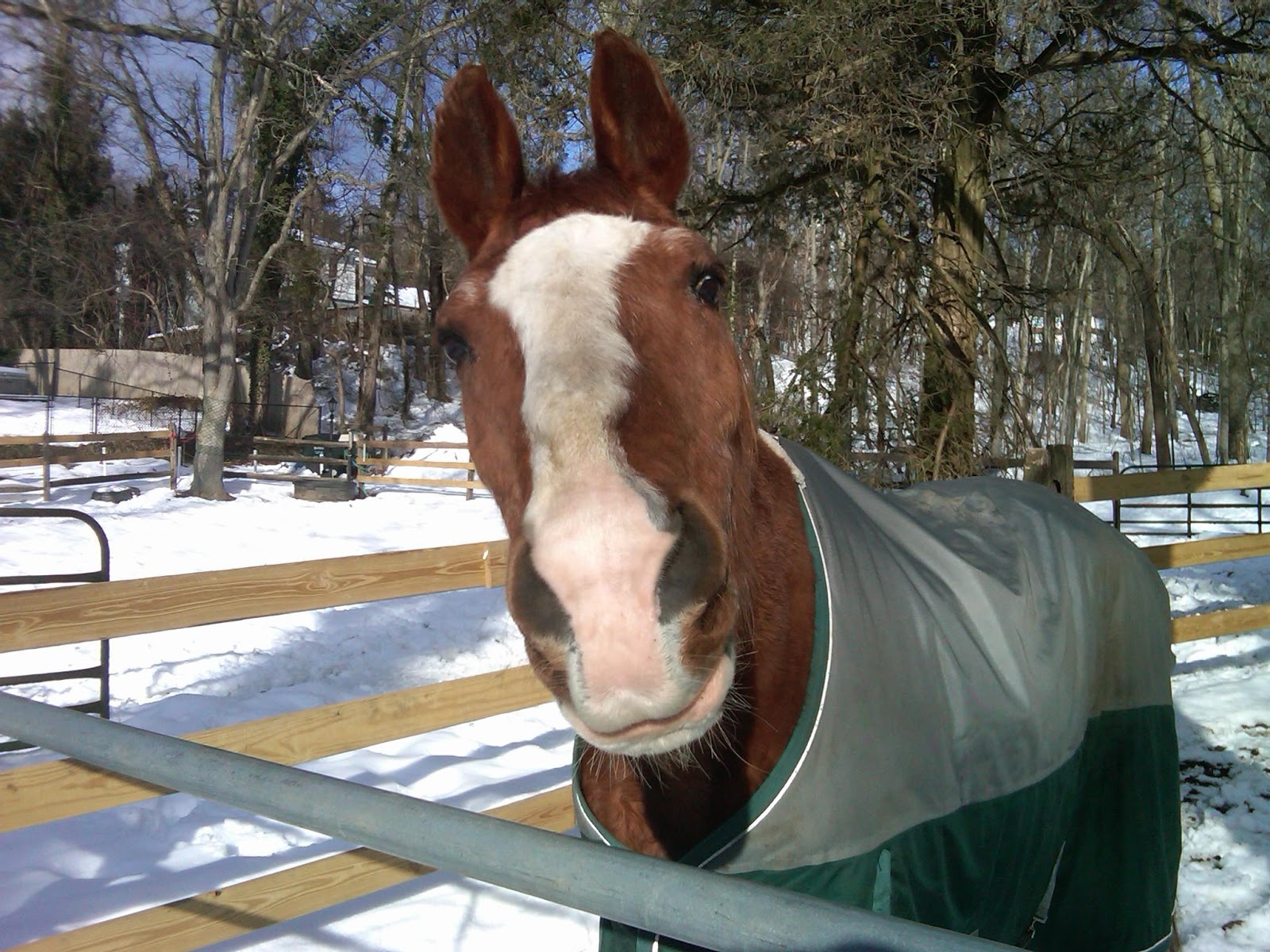
Showing posts with label horse. Show all posts

Sunday, July 24, 2016

FINDING CONNECTION

FINDING CONNECTION
By Tom Gumbrecht

Originally published in Horse Directory, August 2016

My horses are pleasure horses; being in their company gives me pleasure. There was a time when riding was everything, at first casual and then in local competitions. I may not have yet realized it but the picture I was attempting to paint was one of the human-horse relationship; combined training and jumpers were my medium. While I enjoyed the ribbons and still have a few hanging up, the real payoff for me was how completion validated the strength of our partnership and the effectiveness of our communication.

The author with Bella, who was once
considered aloof.
 The partnership was enhanced in the training arena and culminated in the show ring or the cross country field. But it was really created in the stable, in the day-to-day caring for my horses' basic needs and sometimes special needs as well. That's where we, human and horse alike, learned to trust one another and to develop enough faith in that trust to sometimes go against our instincts and rely totally on the other being. I found that a much harder quality to develop than some of the technical skills.

For better or worse, it seemed that the tightest bonds were created when I was caring for a horse that was ill or injured. I was actually able to feel an intense level of trust developing through the heightened level of daily handling involved in their care. It was that soul connection between friends of different species that I had sought; competition had been one means to that end, but it was becoming evident that it was not the only means.

Bella was not my horse, but I was always responsible for her. She belongs to Samantha, who had multiple successful seasons in jumpers with her when she was home in high school. Bella was a very talented horse, but she was a hot blooded Arabian mare who was concerned about everything. Samantha was one of only a few people who could ride her in competition effectively. They were both accepted at a prestigious Midwest horsey college, and Bella never really fit into their program. While the school touted the qualifications of their trainers, the reality was that these big name trainers only worked with the top human and equine athletes. The overwhelming majority was taught by other students, who in this case were well-meaning but  inexperienced in dealing with a horse like Bella. She became confused and seemed to be losing her spirit. I ended up bringing her back home before her fourth semester was finished, with a mysterious lameness that no one seemed to be able to pinpoint.

Bella had been the most aloof of all of our horses, and often resisted human attempts to show
The author learns that Bella's trust
needs to be earned and cannot be
rushed.
affection. I noticed a subtle shift in attitude when I showed up at the college-town stable to bring her home, something hard to describe; a renewed intensity in her eyes perhaps, and a much more vocal greeting when she became aware of my presence. She associated me with home, it seemed, and she wanted to go home.

In the time that has passed since then, Bella retired from jumpers, but shockingly for such a hot blooded mare, became a rock solid trail mount; I could see the attentiveness in her ears and feel her confidence through reins and seat. She has had issues that sometimes affected her soundness, and at those times required a more intensive regimen of care than normal. As I have now grown to expect, during those times we have become noticeably closer. Recently she has had a few different issues which required a good bit of attention from me, and I actually became aware of an increased sense of trust and gratitude radiating from her. Bella actually is a very affectionate horse, but needs to be allowed to express it in her time and on her terms.
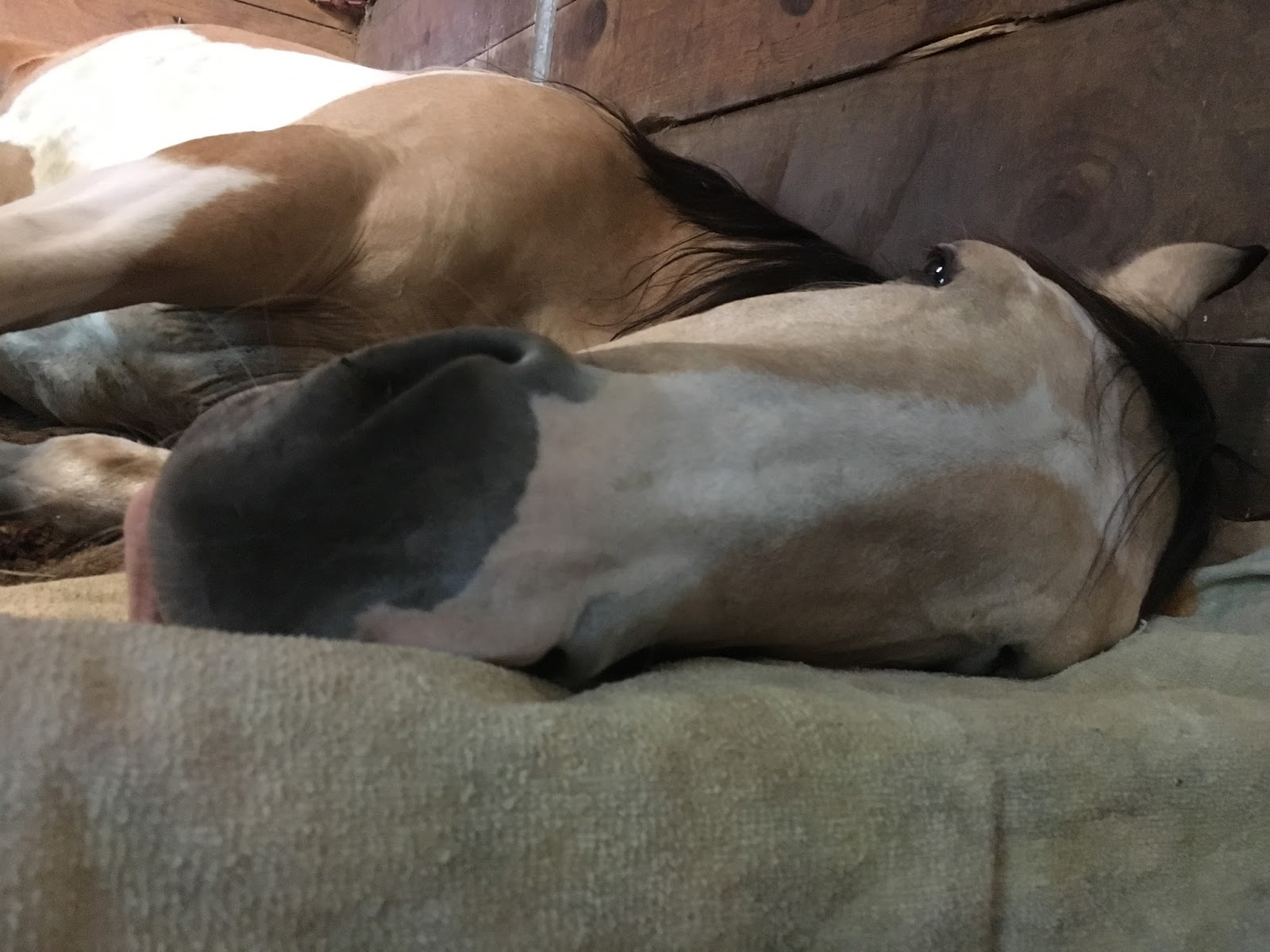
Nap time with Bella.
On a recent summer Sunday morning I lingered in the barn aisle after my chores were completed, drinking my coffee and reading the newspaper. I glanced up from my chair and didn't immediately see Bella, so I stood up and then realized that she had lay down in her stall in front of the fan and was taking a nap. I slid open her stall door to check on her and she raised her head up, looking slightly annoyed at the intrusion.

 Curious, I sat down next to her in the stall with my back against the wall and my legs stretched out in front of me. Her head was to my right, and to my left I kept the stall door open in case she decided to get up and I needed to quickly get out of her way. I made a couple of attempts to stroke her neck and each time she pinned her ears slightly and gave a swish of her tail. So I let her be; she was obviously not fully comfortable with the situation. I just sat there and watched her ears come forward slowly and her eyes lose some of their intensity. I sat still for five, then ten, and ultimately almost thirty minutes when she let out a low groan that might have been concerning had it not been accompanied by the lowering of her head onto my chest and her breathing her breath into mine. Before I was even able to process what had just happened, she let out a nicker that shocked me not only by its volume in my ear or the reverberation in my chest, but also by being totally unexpected.  Bella did not often nicker.

Bella enjoys helping us with our farm chores.

This horse had wanted to connect as much as I did; I needed to find the patience to let it be her idea, to earn her trust and not attempt to force it. My patience was rewarded with a clearer understanding of what it is that I seek from my relationship with our horses. I seek to connect at the heart, and once in a while if I'm ready to receive it, the gift is bestowed upon me.


Sunday, July 3, 2016

KICKED FROM COMPLACENCY

KICKED FROM COMPLACENCY
By Tom Gumbrecht

We've all had it drilled into us: "Don't stand behind that horse, don't walk too close to that horse, don't pass so near to that horse, you'll get kicked! We find ourselves repeating the same doctrine to novices and people whose horse sense we are unsure of.

Lola's racing days. Were there things from
her past that she couldn't tell me about?
We also develop a sixth sense about the horses under our care: we get a picture of a horse's emotional condition beginning at dawn when we flip on the barn lights and walk by his stall. Is he calm? Still groggy from sleep and not alert? Concerned? Agitated? Scared? A horse tells us with his ears, eyes, and body just which version of him we will be dealing with that day, and we gauge our interactions with him accordingly. 

But sometimes, complacency can set it. At least I've found that to be true, especially with a horse that we've known for a long time, and formed a close bond with. It might start out as a small transgression, such as crawling halfway under a horse to paint a hoof rather than getting up and walking around to the other side. If anyone else is in attendance, we might throw out a disclaimer, "You should never do what you see me doing right now," as our actions belie our words.

So it was with Lola, the Thoroughbred mare we had acquired two weeks off of the
Lola, the sweetheart of the herd,
still feels her oats.
racetrack where an injury had ended her promising career. During her lengthy rehabilitation and recovery period, we formed a bond and mutual trust that was unbreakable. That trust was hard-won and very real, but I was probably just a little more conscious of my movements around Lola than with our other horses. Any quick hand or arm movement around her or over-zealous use of a manure fork in her stall had the potential of causing her lightening-quick reflexes to send her retreating smartly backwards into the stall wall. There were things in her past, it seemed, that she was unable to tell me about.

We knew a lot of things about each other, and made allowances for them; that's what enabled our relationship to work. I never thought of her as difficult, but she was very sensitive. Lola may not have been 100% trusting of anyone, but from what I observed in nine years caring for, training and riding her, there was no other human that she trusted more. She would give the boss mare, Bella, a very wide berth and back down in any situation that had even the potential of conflict, her strides being very tentative. With me by her side though, she would confidently prance right past her, ears forward, with a purposeful stride. Sometimes I would chuckle to myself that maybe she had a little too much faith in me; Bella could easily take us both out if she ever had the mind to.

Lola's stall, the scene of the crime.
Mine, not hers.
One recent evening after returning home at around 9:00 pm, I headed out to the barn to put the horses in for the night. I switched on the paddock lights, and Lola meandered over and made her way past me and into her still darkened stall, like she always does. As she passed, I noticed something on her underside, maybe a small burr, and instinctively reached out to touch it, forgetting for a moment that I had placed myself beyond the scope of her peripheral vision. My next recollection was of a wrenching pain in my gut, a blinding light as my eyes were looking straight up into the paddock floodlights and a sharp, hard thud that was my head hitting the ground. For the first time in eighteen years around horses, I had taken a kick! I next had a unique view of what a horse looks like when she is jumping, from the point of view of the jump. Lola bolted out of the stall and jumped over me in her hasty exit, being mercifully careful in where she placed her feet. Or lucky. I got myself up and tried to make sense of what had happened. There was blood all over my left hand and as the shock wore off I started to hurt everywhere. It took me a while to get the horses in after the commotion, especially Lola, who had retreated to the far corner of the paddock and needed to be coaxed and reassured that there would be no repercussions to her fear-based reaction. All of her movements were now very jerky and tentative as if she were waiting to be punished. I lingered by her stall door for a long while before turning away from her, and only then did she cautiously approach and put her head out and bury her nose in my chest. It's ok, girl. Your body reacted totally on instinct which is a part of your blood and bones. And I know better. No hard feelings.

After I had made my way up to the house to be checked over by my wife Mary, a nurse
Someday, young Daniel, I'll tell you all  about
your pal Lola, when she was known as
One Precious Gem.
by profession, I went to bed but although I was very tired, sleep would not come. What kept me awake was not the fear of playing out "what if" scenarios, but rather an intense feeling of gratitude. The last few months, I have been exposing my two year old grandson, Daniel, to the wonders of horses, to the delight of all humans and equines concerned. It occurred to me that I had at some point started thinking of our horses as big teddy bears, and perhaps unconsciously transmitting that attitude with the best of intentions but the carelessness of familiarity. I was very grateful that it was me that paid the price for that lapse in judgment, and not Daniel. It was a very small price to pay for an important and timely refresher course. They are not teddy bears. They are horses.

The fact is that I had frightened Lola and she responded the way frightened horses do. Then she laid low for awhile, then allowed me to walk her back to her stall, and when she thought it was safe, came and expressed affection. I am grateful because Lola teaches me how to be: there was an overreaction to stimulus, a retreat to regroup, then a making of amends. I had to wonder, if this had been a human-human interaction, would it have been resolved so quickly and amicably?


Sunday, January 17, 2016

A BRIDGE BACK TO LIFE

A BRIDGE BACK TO LIFE (Crossed on Horseback)                                                                       Originally published in Horse Directory,  Jan/Feb 2016

By Tom Gumbrecht

Have you ever experienced a phenomenon where a number of seemingly unrelated chunks of time and events conspire to fall together in place, like pieces of a jigsaw puzzle? Sort of like standing too close to a heavily pixilated image and then all at once becoming aware of an awesome image upon viewing it from the correct distance and perspective. So it was with the story of how horses entered my life and how important a role they ended up playing in it.
Buddy was one of the first horses who helped me to put the pieces of
the puzzle that were my life, back together.


My life and career had been seemingly progressing pretty well when I was in my thirties. I was married to Mary, who was pretty, hardworking, fun and supportive. We bought a house in a neat, beachy community on the north shore of western Suffolk County, had good jobs, travelled and had a lot of cool stuff. As a self-employed trade contractor, I liked to work hard and I liked to play hard and the play time usually included alcohol.

It started out innocuously enough. Drinking was a way to put the worries of business and the responsibilities of being an adult on hold for periods of time in order to let go, have fun and not be consumed by the worries of life. And it worked. For some people, that’s as far as it goes; perhaps an occasional overindulgence at a social event, but nothing to elicit concern. But some of us are wired differently. For some of us, drinking progresses to the point where it no longer facilitates and enhances fun activities… it becomes the activity. When that happens, we might surround ourselves with like-minded people, and in so doing create a new normal- one where frequent overindulgence is not frowned upon nor regaled, it is just accepted.

That is exactly where I found myself at around age forty. The lifestyle was beginning to take its toll, and some incidents shined a light on the problem which I had no choice but to come face-to-face with. I had spent many years trying different methods to drink like a normal person, to no avail. It was confusing, because I was quite successful in dealing with other of life’s problems. The solution to this one, though, remained elusive. The problem was my insistence on finding a way to manage something that to my body, was unmanageable. The answer was a simple one, but not easy: avoid it entirely, a day at a time. That proved much easier said than done of course, because at a point the addiction to alcohol affects us on a physical, mental and spiritual level. When something that had become such a big part of life is removed, something has to take its place. It can be a bad thing or a good thing, but that void will be filled.  For me, that something ended up being horses.

On a day like any other, a few years into my newly sober lifestyle, my phone rang. On the other end was a well known LI Hunter/ Jumper trainer (a fact completely lost on me at the time) who needed a barn rewired. I took the job and found myself utterly fascinated with the horses, horse sports and horse people. Interestingly, during my drinking years I never really found out what made me tick, what I liked, what I was drawn to, where my passions lied. I engaged in hobbies and pursuits that I perceived were cool, or made me look cool, whether or not I was well suited to them. If that ever made me uncomfortable, the alcohol was there to smooth over the feelings.
In my world, horses were perhaps aesthetically pleasing and had a formidable presence and required some skill and courage to master, but they were not cool so I never had given them a second thought. In fact, I didn’t even know anyone who had taken up the pursuit seriously. But an interesting thing happened: In being around them over a period of time, I found a strong emotional attachment to horses, I loved being around them and I could not wait to learn how to ride. I brought my eight year old niece Sam with me and we set out to learn to ride as two green newbies at a barn full of mostly very experienced riders.

Very clumsily at first, I pursued my new riding career with a passion that quickly earned me some credibility in the ring, not due to accomplishments, aptitude or ability but by sheer dedication alone. In the process of learning the technical aspects of riding, I found myself the recipient of a totally unexpected gift: The physical manifestations of my drinking had not caused any permanent damage and were pretty much addressed by the act of stopping alone. The mental aspects required a little more work, which was addressed by learning as much as I could about alcoholism and allowing myself to be put into a position to be supported and to support others. It was the third component, the spiritual one, to which a solution seemed elusive. This was a soul sickness borne of the realization of the extent of the damage that had been done and the denial which had clouded my judgment for so long. It was toward that third, spiritual facet that horses began to fill the hole in my soul that alcohol never could. They held for me the keys to what I now think of as a new freedom and a new happiness.

So, stepping back once again from that fragmented mosaic, I could now see that an awesome plan had been laid out for me, and I had been in the right place at the right time with the willingness to follow it. Spiritual healing was important because as ex-problem drinkers, we find that people, especially those whose lives or the lives of those close to them have not been touched by alcoholism, can view us with suspicion, condescension, judgment and pity, none of which are how anyone wants to be treated. Horses, however, do not care about our past, nor do they care about our worries about the future. They live in the now, and we learn, if we are motivated enough, to live in their world and on their terms. It is from the “now” that we commence to heal, not from any point in the past or future, and a horse can be an ideal partner in the healing process. We learn to be honest because horses respond only to who we truly are and not to the person we pretend to be or think they need us to be. To be accepted simply for who we are creates a feeling of belonging and of having a place in the universe. It is an experience not to be missed.

That picture and the plan represented by it gained a more crystal clarity in the life events that followed in ensuing years. We became parents to our young niece Sam who I had brought to riding lessons with me, after her mother died at a young age. By that time our involvement with horses had increased to the point where we had our own small farm, and our horses were the catalyst which helped the relationship between middle-aged, first-time parents and a young girl who had her life turned upside down, to work.  A regular program of lessons and training led to competitions with Sam enjoying many successes in the jumper ring with her Arabian mare, Bella. Sam and Bella attended a horsey college in the Midwest and returned home with both having grown in their knowledge and abilities. As an empty nester, I entered the show ring with my APHA gelding DannyBoy, having reasonably successful seasons in the eventing field and the jumper ring. Sam has now presented us with a beautiful grandson named Daniel who is a new source of joy and is being raised on our farm with dogs, horses and love.

It was, and is, a beautiful plan which was invisible until my eyes had become clear enough to see and follow it. And it’s not finished yet. The key to happiness, I’ve found, is not creating a constant flow of stimulation and excitement that I once thought it was. The key, for me, is having something to do, something to love, and something to hope for. Horses have provided, and led me to, all three.

Epilogue:
Alcohol can surely be used by many as it was intended to be. When we find that we are having trouble with control, my experience has shown me that by the time that level of awareness is reached, a problem usually exists. If you find that you or someone close to you wants to put some controls on their drinking and can’t, I’m telling you that you are not alone. If help is sought and accepted, no one has to drink who doesn’t want to. The thing is, most of us play with the illusion of control far too long, but it doesn’t have to be that way. Good luck and God bless.


Saturday, August 1, 2015

NEW BEGINNINGS: The Birth of a Horse Farm


NEW BEGINNINGS – The Birth of a Horse Farm        

Originally published in Horse Directory Magazine,  AUGUST 2015

By Tom Gumbrecht

I like my job as a self employed electrician, I like horses, and I like helping people. Occasionally I get to put the three of them together, and that, I love. It's the most fun part of my job. When someone hires me to do a job, I become part of their life for a period of time, which depending on the size of the project could be hours, days, weeks or months.

Recently playing a small part in having a new barn owner
realize her dream of a beautiful new horse facility.
We have occasionally in the past used these pages to lament the closing of horse farms on Long Island, and the mixed feelings generated by being both a horseman whose passion depends on preservation of open space, and a tradesman whose livelihood depends on progress and development. But sometimes, development comes in the form of creating a new horse farm. When that happens, I feel no inner conflict. It's the best of both worlds, and I'm in my element. As a professional electrician, I have acquired the knowledge and experience to properly advise clients on the unique electrical requirements for horse barns. As a equestrian who evolved from student to rider to competitor to horse owner, I made the leap to barn owner and horseman. It was more than a new title, it was a totally new lifestyle and I know really well the mental gymnastics that go along with taking on such a life changing commitment.

I've been around the electrical trade for over forty years so I'm ok with being called an expert in my field.
Putting the finishing touches on a new
barn as its first occupant moves in.
I've been around horses for seventeen years this month, not a long time in the horse world by any means, so I don't consider myself an expert in the world of horses. What I do have is experience, the willingness to share it and a true desire to have others learn from my mistakes. That puts me in a unique position to sometimes be able to be of help when someone makes the leap from being a rider and a horse owner to taking on the role of barn owner/ manager, horse caregiver, groom, chauffeur and vet tech, not as an expert so much as a coach. When I get hired to wire a new horse barn for a first time barn owner, I frequently also become a de facto backyard barn consultant.

I look at your eyes when you begin to speak of your horses and the prospect of having them at home, and maybe I see the same sparkle that I had at that point and I share in your excitement. You are a sponge for knowledge and we will likely speak of things like grading and drainage and proper access for hay suppliers and farriers and veterinarians and the management of manure.  We might touch upon arena construction and maintenance and tractors and trucks and trailers.  A million things that never needed to be thought of but now demand to be addressed: stall footings, bedding types and storage, lighting, ventilation, water service, plumbing, snow removal, handling of sick and injured horses. These are the things we rarely needed to think about as boarders: hay and grain storage, fencing types, fence maintenance, gate placement, hot wires, stock tanks and heaters, blanket changes during the day, management of meds and supplements and special equipment and secure storage for tack. The list seems endless and the details can become overwhelming.

A decrepit swimming pool is transformed
into a riding arena at the author's barn.
There are a million places to get technical advice online today. Everyone has an opinion and some are convinced that their way is the only way. I try not to add to the confusion because I’m just sharing my experience. By the time I get to see you, generally your mind has already been made up.  You have made the commitment to keep horses at home, and are now getting caught up in details, perhaps second guessing and experiencing self-doubt. What I try to convey is my belief that if you have the commitment, you have it all. When things turn difficult as they inevitably will, commitment finds a way. Commitment doesn't think twice about spending a night in the barn to make sure an ailing horse is all right. Commitment happily makes personal sacrifices so that the horses don't have to. Our horses grow older but they never grow up. They never outgrow the need for our commitment. If you have it, you have everything it takes, for everything else can be learned. If you don't have it, even with the best horses in the most well-appointed stable, you don't have much at all.

When I sense that commitment, I use the opportunity to offer my hope, confidence, and an underlying assurance that everything will be all right. The naysayers and fear-mongers have all taken their best shots at you, and you have decided to do it anyway. Now you need to know that you can do it, and I offer myself as living proof of that: an ordinary person with ordinary skills, ordinary athletic ability, ordinary finances, and perhaps a level of commitment that's a little above average. I share the fears I once had so that you know you are not alone when you experience them. Sometimes, I get to be there when your horse comes home for the first time. You can't believe that this is actually your life and all the planning, paying and working has now culminated in you having your own farm. It's a privilege to be able to share in that, and it’s one of the best parts of my job.

Sometimes when the struggles of working and being in business occasionally wear on me and I wonder what
Nothing like bringing a new horse home to a new barn.
Here, the author's mother-in-law Connie welcomes Magic.
life would have been like had I made different choices, I remind myself of the benefits of the opportunities that sometimes cross my path: I get to provide a needed service, for people I enjoy being around and share a common interest with, and perhaps pass along some of the passion I've acquired for the horsey lifestyle.

I got to see for myself how horses could transform a life from the average to the passionate and committed. To witness that phenomenon in others is especially gratifying.


We don't get to speak "horse" on the job
all the time, but it's fun when we do..


Wednesday, July 1, 2015

A JOB WITH BENEFITS

A JOB WITH BENEFITS           
Originally published in Horse Directory,  July 2015

By Tom Gumbrecht

I’ll be 62 this month. For some, that means thoughts of retirement, but for me, being self-employed, not so much. I enjoy my work anyway. Still, it has fostered thoughts of what life will be like when the aging process continues it's slow erosion of a body whose work and recreation have been of the physical kind. I've been lucky in that regard, so far.

Sometimes the physical demands of horsekeeping
can be great.
Keeping horses is a physical endeavor, and each year the demands are a little greater, no doubt exacerbated by the harsher winters we seem to have been experiencing. The winter chores are the most difficult, and can seem at times to be an un-winnable battle.

The prospect of one day being on a fixed income brings other concerns about sustaining a horsey lifestyle. Even owning the facilities and doing all of the work ourselves, it's still a significant expense. We've moved on from competing regularly and although we still train, it's for the continual development of horse and rider rather than the clear goals of competition. We do take the horses to the park for trail rides as time and weather permit, but it seems that most of what we do consists of horse care and farm maintenance.

That's the side of the story as might be told by a financial planner, but as we all know, there's more to it than that, and another kind of cost/ benefit analysis:

 I have a reason to wake up early each day. The first hour of every day is spent in a tranquil environment where I am gently but enthusiastically greeted by soft nickers and soft eyes that say “welcome.”

It's said that there is much peace to be found in organization and routine, and that may be part of the reason that I feel so peaceful in the barn. It is one area of my life that is well organized and the routine is familiar.

Much is said about the benefits of living life from the point of view of gratitude; it's kind of the latest pop-psych buzzword. Our barn is a world filled with mutual gratitude that is clearly expressed when I take the
The author, Samantha and DannyBoy introduce
grandbaby Daniel to the world of horses
time to listen. Intentions are clear, and there are no hidden agendas. Actions are the main tools of communication and words are unnecessary. The is no ambiguity here. What you see is what you get. Relationships are easy when you always know where you stand.

I was able to uncover a hidden passion for horses that transcended riding, not to downplay that part. But I discovered within me certain qualities, a patience, a teach-ability if you will, and the willingness to care for ill and injured horses. When a human is sick or injured, my immediate reaction is to call someone equipped to handle it, and take the role of support staff. When an animal is injured, my reaction us to jump in immediately, do what I can, and call for help later if needed. Are my priorities misplaced? I don't know. Theses are qualities that have surfaced that I seem to have been born with, so I attempt to make the most of them.

It's a nice thing to start and end each day with the feeling of accomplishment of clear needs squarely met. It helps to balance the frustrations that daily life and business can sometimes bring. People make extensive plans to attend spiritual retreats in order to connect more closely with a Higher Power, God, the Great Spirit, the Universe or whatever name we wish to give a power greater than ourselves. I have the privilege of living such a retreat daily, at least for a few hours.

Those are some of the line items on my cost/ benefit analysis, understood fully by those fluent in the language of the heart that is spoken in the barn.

Knowing that the horses are securely tucked
in gives a warm feeling.

Thursday, June 4, 2015

RESIST NOT CHANGE

“RESIST NOT CHANGE”
By Tom Gumbrecht               Originally published in Horse Directory Magazine, June 2015

The list of uncomfortable changes that I've gone through in my life with horses is an extensive one. To the casual observer, it might seem like some really bad luck in copious quantities. Here are a few highlights:

Circus gave the author many firsts,
including his first unintentional dismount.
The first seems so minor now, but it felt like a big deal when it happened. I began riding at a lesson/ show barn. I enjoyed my lessons and free riding on the flat, but I kept exploring the far reaches of the property during cool-down, secretly always wanting to canter the vineyards across the street. I finally talked my trainer into taking me over there, and within the first minute my horse got spooked and after a bad spin I hit the ground and my horse high-tailed it back to the barn, crossing an active roadway in the process. I emerged from my first unintentional dismount ok physically, as was the horse, but I was riddled with guilt for having pushed and pushed to do something that ultimately put a horse in danger. I vowed to never leave the safety of the property again.

The next episode was a tough one. I had slowly become part of the horse culture, if not yet the show culture, of the wonderful barn where I had learned to ride. It was my first exposure to a barn family and I was accepted into it. Life was good. And one day it all changed when the owners made the decision to relocate out of state. The farm was sold as a non-horse property and the horse facilities were dismantled. My comfort zone and new-found barn family just evaporated. My riding life was over.

In another instance I found myself in a rough board situation, sharing a horse with a very experienced owner who no longer rode. I had almost unlimited access to a really good horse, a wealth of knowledge at my fingertips and magnificent trails on an adjoining preserve that no one else used or even knew about, for the price of some hay. All this within 10 minutes of my western Long Island workplace! It seemed to be too good to be true, and I guess it was. There developed some conflict at this little barn that ultimately made the arrangement unworkable. With a heavy heart I had to say goodbye to what seemed like paradise.

The first horse I ever actually owned was perfect for me. He had a great personality, and was older and
Buddy, the first horse owned by the
author, seen with mom Helen..
tolerated my frequent gaffes and miscues with aplomb. Although a senior, he still had plenty of spunk and gave me just enough of a challenge to make our rides interesting without being dangerous. We rode for three years when he got sick and could no longer be ridden. His illness was all-consuming, emotionally and financially. It felt like being on a roller coaster: the highs reached with short-lived improvements and the lows terrifying with more setbacks.

Our second horse was a stalwart. She was, dependable, healthy, honest and fun. Always there, always up for anything and a great baby-sitter. A senior also, she brightened our days for four years, when she had a bad colic and was gone within several days of taking ill. It seemed as if our dreams were star-crossed.

A point came sometime later where I had gained enough experience and confidence to enter the world of horse showing. In the small world of eventing on Long Island, I had acquired a courageous horse with a natural talent that we developed with the help of a trainer and did well in the lower levels over two years or so. Unexplainably he injured his suspensory ligament and had to have surgery which put him, and me, out of the
DannyBoy with the author at an early eventing show.
show ring for 18 months. If it weren't for bad luck, it seemed I wouldn't have any.

My focus was diverted to a side project at one point, and myself and another person planned to try our hand at procuring an OTTB at auction, retraining and showing the horse and selling it before picking up another in a small effort to give some ex-racehorses a new start. A magnificent plan which fell apart 24 hours after we picked up our first one at New Holland. The following day the drugs that had apparently been given to this very recently off the track mare, wore off revealing an injury that would have her incapacitated indefinitely. My project partner was understandably not up for this level of challenge so I found myself in way over my head and alone. It was beginning to look like I should have perhaps taken up a different sport. But things are not always how they initially seem…

So here is, as Paul Harvey used to say, the rest of the story:

The incident in the vineyard did not lead to never leaving the supposed safety of the riding ring again. Instead, it enticed me to find a different and safe venue to explore trail riding. While still learning to be a better technical rider on my leased horse at the farm, I would supplement that with weekly (or more) trail rides at a local hack stable. I learned to ride many different horses under many different conditions and met a lot of people who shared my enthusiasm.

The closing of my home barn set into motion a creative quest to stay connected to horses in some way. That
Magic was dependable, brought comic relief and
gave us our first lesson in letting go.
led to the rough board situation where I learned from an expert, how to care for a horse’s needs in addition to riding. This was experience that would become invaluable later. A short time after I was forced to end that situation, I resignedly answered an ad in the newspaper seeking volunteers for a local therapeutic riding program, simply as a way to, again, stay connected. What I got was much more. I experienced another side of the horse world where horses were the teachers, counselors and therapists. I again expanded my network and made what have become lifelong friends. I was reintroduced to formal training through renewed contacts from my first barn who had resurfaced, and joined some of them at a local HJ barn where I proceeded to pursue my dream of becoming a jumper rider.

The difficult loss of relationships with horses, and its effect on me, prompted my wife to suggest that I get my own horse. I expanded on that to include getting our own barn and she went along with it! That's in effect how Dreamcatcher Farm got started.

My first horse’s illness was devastating for him, inconvenient for me. When I finally was able to see things that way, I was able to use the skills I had learned at the rough board barn to keep him comfortable and nurse him back to health. That was a long journey but along the way I became a horseman. I learned how to not give up when situations looked dire.
But I needed another lesson. I needed to learn when and how to let go, and our second horse, the mare, taught me that hard lesson. That there was a difference between giving up and releasing with love. Later, the untimely injury of my event horse allowed me to spend a lot of time just being with him. He was (and is) a take-charge kind of guy, and although we worked very well on course together, he was not an easy horse to bond with. Hour-long leg treatments, wrapping and handwalking every day for many months provided that opportunity and provided valuable experience for what would become my next challenge.

Lola, not long before she landed at the author's stable.
The lofty dreams I had for my beautiful, muscular ex-racehorse were dashed when the veterinarian confirmed our fears of a serious front leg injury. I felt as if I was between a rock and a hard place, and I didn't know if I could willingly take on a situation as grave as this. Yet the alternatives seemed to be to misrepresent and re-sell her as had been done to me, or euthanasia, and I wasn't willing to consider either. As I wasn't able to fathom the level of commitment that I would need to muster, I just took things a day at a time. And a day at a time we worked, and we bonded; we were jubilant with small victories and crushed by setbacks. We asked for help when we were in over our heads, which was frequently. And she got better, and I got better. She didn't know much except the racetrack, and how to be a good horse, but that ended up being enough. We got trained to train her, and we did. And we got to ultimately be the person in the irons when she trotted into the show ring in front of the first crowd since the one at her last racetrack. That remains my most cherished ribbon.

Through her and all of the others I found my little niche in the horse world. It wasn't bad luck forcing situations upon me, it was the universe opening doors that I would not have otherwise known were there. The thing is, I wouldn't have chosen any of these situations had I been given the option. Were they good things or bad things? Neither. They were necessary things. Necessary in order to bring me to the point where I am now, which is prepared for unknown opportunities already on their way.

Even though I seem to not always remember it very well, things work much better for me when I live my life in preparation for something better to come.


Saturday, May 2, 2015

HORSES AT HOME

HORSES AT HOME                  
                                                                  Originally published in Horse Directory,  May 2015

By Tom Gumbrecht

Should I keep my horse at home? Many horse owners have considered that question at some point in their horsey lives.

To those expecting an in-depth analysis of the financial and practical pros and cons of keeping horses at home, I apologize. You won't find that here. I am a fairly practical person in other areas of life, but when it comes to horses, practical is not the first adjective that would come to the mind of most in describing me. This is just a story about my very unlikely journey from a green-as-grass newbie to a rider, horse owner and barn owner.


Dreamcatcher Farm.. before the bulldozers
 When I was first introduced to horses and riding at age 45, I had been through a few hobbies already. I was a private pilot at age 20, captained my own sailboat at age 29, and was into semi-extreme off roading at age 42. I had always jumped into my pursuits with both feet, became completely immersed in them, reached a certain level of competency and then began looking for the next challenge.  I didn't plan it that way, but that's the way it always seemed to happen.

I experienced probably all of the frustrations that an adult beginner experiences, sometimes thinking that it would be prudent to just give up, but I never seriously considered that.  I investigated many disciplines along the way in an effort to find my niche. I met jumpers, hunters, trail riders, reiners, barrel racers, dressage riders and most seemed to have found their way in the horse world. They were pleasure riders, competitors, those seeking to experience their personal best with their equine partner. Some no longer rode at all, and just enjoyed the social atmosphere of the barn, and the bonding that takes place while hand grazing and grooming and just being with their horsey friend. I could identify with all of them, but since all of my acquaintances at that time were boarders at commercial barns, I had never met many people who had the aspirations that I did: to have my own barn and have horses at home.

Oddly, this wasn't a dream that built up slowly over time.  I realized it as soon as it seemed that my interest in horses was more than a passing fancy. It was reinforced when, several months into my training and to the shock of my friends and family, it seemed quite sensible for me to lease my first horse. Still, the idea of owning a horse property on Long Island seemed unattainable. Then, something else happened.
 
Riding ring base going in.
About a year and a half after my arrival at the barn, it was announced that it would be closing in a couple of months, being sold to a non-horsey purchaser, and the owners were moving out of state. The owners, touting the climate and value of the area they were moving to, sent me listings of horse properties in the area. While relocating was not a real possibility, my interest had been piqued, and at this time the real estate business was beginning to have a big presence on the internet. Looking at properties, once an arduous process of endless rides with agents on weekends, had now been streamlined to the point where one could sift through a hundred or more properties or more in a single evening on the couch. And so it was that I began a “just for fun” search for horse properties on Long Island.  After meeting an agent who was also a horseman, the idea was planted to search for, rather than established horse facilities, properties zoned for horses and properly laid out to accommodate a barn, paddocks and riding ring that we would build ourselves.

Beginning to look like a barn..
Being in the construction trades, the prospect of such a project was not daunting; rather it was kind of exciting. We made a list of things we needed to have and things that we wanted to have and within a couple of months found a place that met just about all of our requirements. What started out as not much more than a lark, ended up in the realization that by doing a large amount of the work ourselves, we could actually have a horse property in western Suffolk County, Long Island while still being within reasonable commuting of our jobs in Nassau County. And we did buy it, and build it, and so was born Dreamcatcher Farm.

This summer will mark the seventeenth year from the time that I rode my first horse, and this fall the fifteenth year since we bought the property. There have been many challenges that we have faced since then, but the underlying theme for our experiences here has been, quoting from the movie Field of Dreams, “If you build it, they will come.” Many incredible people have come into our lives since we created our little farm, and I remain convinced that raising a family in the company of horses is how I was meant to live my life.
 
Buddy, the first resident of Dreamcatcher Farm.. on his first day!
In working with horses, I have found my proper place. I'm no longer looking for the next challenge because each horse presents a new challenge on each new day.  I have been a farm hand, a student, a competitor, a teacher, a groom, a physical therapist and a nurse. I have smiled much and cried some.  On the practical side, it has allowed me to keep three horses at once, which I could not do in a commercial boarding situation. Why three, non-horse people seem to always ask? Simple: the up and coming youngster, the dependable and confident middle-aged guy, and the one who has done it all and is now mostly retired. I love being able to jump on a horse and ride, having the flexibility to work with a young horse and having the ability to care for a senior.  I love them all for some of the same reasons and some different reasons.

Is keeping horses at home for everyone? I’m sure it isn't. I probably get to ride less than my friends who board, but in my case it was the path that I was always drawn to follow. It ended up being the right path for me. But, assuming that most people who keep horses at home don't employ staff to provide the support and care for them, it is a major lifestyle change, and commitment. Some can't provide that level of commitment, other won't, but for me it just seemed to fit perfectly. It can be a lot of work but as the saying goes, if you’re doing something you love, you won't work a day in your life.

At this point, I have amassed many thousands of days that begin and end with caring for horses. Since the beginning, that has always been the best part of most of those days…
 
"If you build it, they will come".. The author with Buddy,
and a young Sam with Magic.


Thursday, April 2, 2015

LETTING GO

LETTING GO                                                                                             April 2015

By Tom Gumbrecht

Intellectually we who love our animals know that if things play out the way nature intends, we will outlive them and as their stewards sometimes we are called upon to humanely accelerate the natural process.

The brain understands it this way:

Euthanasia (from a Greek word, meaning “good death”) is the practice of intentionally ending a life in order to relieve pain and suffering.

The heart, however, knows euthanasia as “taking our friend’s pain from them and making it our own.”

No matter how completely the brain understands the concept, we are are never really ready until the heart concurs. In my own experience, I was a horse owner for some years before I had to deal with the inevitable.  At that time we had two horses, Buddy and Magic.  Buddy had a myriad of health issues and was only rideable for three of the ten years we had him. Magic, a very sturdy and sensible mare, was never sick and was always up for anything that was asked of her.  Given Buddy's history, I had forced myself to let him go emotionally many times before his uncanny life ended naturally at age 33.  Magic’s health was never a concern so when she suddenly took sick it was very hard to process, but the severity demanded a swift decision that I felt totally unprepared to make.  It was the Tuesday evening before Thanksgiving when the decision was put to me, and I selfishly and unthinkingly wanted to delay the inevitable until the day after the holiday.  My veterinarian, normally a matter-of-fact, practical sort, uncharacteristically put his hand on my shoulder, looked me in the eye and said, “That would be asking a lot of your horse.”

My breath caught. He was right, of course, and I knew what the right decision was. I had not been prepared to let go so quickly.  Arrangements were made, and I did not sleep that night. I remember praying that she passed during the night so that I didn't have to face the task in front of me. That night the most aloof of our three dogs, Mickey, wrapped his body over mine in a poignant display of empathy.  Daylight came and I reluctantly rose to carry out my duty as steward for my animal.  Magic loaded onto the freshly bedded trailer that would take her to the crematory later in the day.  The vet came, and my friends and family were there.  Magic was looking through the slats in the trailer into the paddock and her eyes were locked with Buddy’s who returned her soft gaze. I held Magic until the medicine took effect and when it did, I backed off as her legs dropped out and she fell upon the thick bedding beneath her.  I was totally unprepared for what happened next; as Magic slipped away, Buddy let out a deafening whinny, the kind that if you were on his back when he did it, your whole body would vibrate.  The vet told me this was a common reaction but I never expected it.

As I closed the trailer in preparation for the trip, I noticed that Buddy walked into Magic’s stall and sniffed her blanket on the rack through the open door. He licked the two lead ropes that were still suspended from the ceiling, which had been holding her IVs, and I thought the whole scene touching. As I started down the driveway with truck, trailer and Magic, Buddy, normally as quiet and serene as you could expect a horse to be, bolted out of Magic’s stall, wheeled around and kicked the top rail of the fence closest to us, shattering it and sending splinters flying toward us as we exited the farm. When I returned later that day I was told that immediately following our departure Buddy went back to grazing on bits of hay in the paddock as if the day were like any other.  Buddy went through the entire grieving process in twenty minutes, and in doing so, began to educate me in the art of letting go.

I have lost many animals since that day, some naturally and some whose passing I had to help ease. Does it get easier? Actually, yes, because I no longer try to avoid the feelings that inevitably accompany euthanizing a friend. I don't try to manipulate them, or myself, and basically just let them run their course. Sadness is an appropriate feeling so I allow myself to be sad.  I allow the emptiness to come, and then to go. I no longer cling to it as I once did, thinking that prolonging my sadness, guilt and emptiness was a form of respect for my departed friend.

We recently lost a dog, Dusty, who had been with us for twelve years. His health had been slipping but he still had an obvious quality of and zest for life.  That changed very quickly one recent evening when he had a neurological episode that left the rear half of his body paralyzed and he was scared and confused. We were able to make him comfortable until the vet came the next day and eased his passing. In sharp contrast to my first experience with euthanasia, this was, in a way, a very beautiful experience as I held him gently and felt him lightly breathe his last breath surrounded by the family that loved him during his life. At that moment I felt honored. Brief bouts of sadness and emptiness come to me still, and I let them come and I let them go.

As I have been finding more and more frequently, I find that my animals have taught me many of life's lessons that I needed to learn: to love fully, to trust completely, and to let go. Of all the emotions that accompany the carrying out of what inevitably needs to be done, what I ultimately feel most.. is honored.


Wednesday, November 19, 2014

ATTITUDE ADJUSTMENT

ATTITUDE ADJUSTMENT                                                                                               December 2014
By Tom Gumbrecht

“The longer I live, the more I realize the importance of attitude on life. Attitude, to me, is
Trainer Laura Ruben of Affari Horse Farm teaches the author about the
patience needed with a young racehorse, first by watching and
then by doing.
more important than facts. It is more important than the past, than education, than money, than circumstances, than failure, than successes, than whatever other people think or say or do.

“It is more important than appearance, than giftedness or skill. It will make or break a company, a church, a home. The remarkable thing is that we have a choice every day regarding the attitude we will embrace for that day.  We cannot change our past… we cannot change the fact that people will act in a certain way.  We cannot change the inevitable. The only thing we can do is play on the one string we have, and that is our attitude. 

“I am convinced that life is 10% what happens to me and 90% how I react to it. And so it is with you… we are in charge of our attitudes.” – Charles R. Swindall

Powerful words… a quotation that someone my age might put in a frame and hang on the wall of
The author beginning over-fence work with Lola
in 2009. Two years earlier we were thrilled that
she could walk.
a young adult perhaps, but notable in that I was introduced to it by my twenty-something trainer a few years back.  She had adopted it into her life and is a living testimony to its accuracy.

I have had more than one teacher of this concept in my barn; one in particular left the racetrack injured and showed up for our date with destiny at the New Holland auction. Now a permanent resident of our barn, she goes by the name of Lola.  We didn’t know that Lola had an injury because an unscrupulous seller had medicated her, disguising a severe lameness. A day after we got her home she was walking on three legs and a veterinary exam was not encouraging.

Sometimes my initial reaction when faced with a situation I can’t see my way out of is to feel sorry for myself, and this was no exception. I had just gone through treating a severe, multi-year illness with my gelding, Buddy, and I felt that I couldn’t endure that terrifying roller coaster of emotions once again.  Poor me..

After a day or two of trying to figure out how to get myself out of the situation, I soon came to grips with the fact that Lola and I weren’t going to be riding off into the sunset in pursuit of eventing ribbons anytime soon. No, we now had another injured horse to try and mend.  Once focused and armed with a rehabilitation plan from the vet, we began the daily work needed to give Lola a chance. But how would I ever find the time to do this day in and day out? It was still all about me, my bad luck, my disappointment, my frustration. What I needed was a severe attitude adjustment, and Lola gave it to me.

In 2014, the bond formed by Lola's attitude and the author's
attitude adjustment was now unbreakable.
Did you ever have a dog who, after you left her for two minutes to run out to get the mail, greeted you as if you had just scored the winning touchdown in the Super Bowl on your return? I have had a few of those, but had never received such an ovation from a horse until Lola.

In the course of Lola’s rehab, we spent a lot of time together, wrapping, unwrapping, cold hosing, hand walking, laser treatments… and after each time I returned after disappearing from her view for a few moments, she would nicker furiously, loudly and continuously. Then her eyes delivered what her voice had promised.  I have seen many emotions conveyed through the eyes of a horse: contentment, annoyance, intensity, submission. I have seen eyes that were agitated, tired and pleading. Lola’s eyes showed none of that. Her eyes reached out through the stall door and connected my being with hers.  It was the look of acceptance.

This look of total connectedness and the vocal assertions of gratitude every time she laid eyes on me were exactly the attitude adjustment that I needed. It was so simple, and so obvious: I thought that the bad fortune of Lola’s condition was my cross to reluctantly bear, when in fact it was Lola whose life had been turned upside down, who had gone from an athlete to an invalid, who went from having a regimented, organized life to having everyone and everything she knew ripped from under her… and yet she seemed to be the happiest horse alive.

This horse had much to teach me, and it wasn’t about riding or competing… although she was to later educate me in those venues as well.  Lola went from being a disappointment (though it pains
The author's wife Mary with Lola at her first
show, Good Shepherd 2012. It was
a long road to get there, smoothed out
by Lola's fantastic attitude.
me to say that now) to an inspiration, because her attitude was infectious, contagious and an absolute joy to be around.  How did I find the time to do all of the things that needed to be done for Lola?  Someone once said, if you want to see what someone’s priorities are, watch what they spend their time doing.  With her attitude alone, Lola made herself my priority.


I thought I had gotten a bad deal for my $500 at the auction that day. What I got was, I got to be a better horseman, a better student, a better rider and hopefully a better person. If that were to be true, I can only guess that maybe some of Lola’s attitude rubbed off on me while in her stall.